


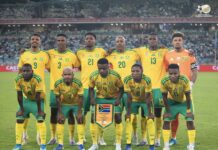

South Africa’s 2026 FIFA World Cup campaign should never be remembered as a failure.
For the first time in the nation’s history, Bafana Bafana reached the knockout stages of the FIFA World Cup—a landmark achievement that underlined just how far Hugo Broos has taken this team. Four years ago, few would have imagined South Africa rubbing shoulders with the world’s elite.
Yet tournaments of this magnitude are also brutally honest. They expose strengths, but they expose weaknesses even more.
If South Africa is serious about becoming a regular World Cup nation rather than a one-off success story, there are several lessons that cannot be ignored.
The Occasion Was Bigger Than Bafana… At First
The opening 2-0 defeat to Mexico set the tone.
It was evident that many of South Africa’s players needed time to settle into football’s biggest stage. The intensity, speed of play and pressure were unlike anything many had previously experienced.
The two red cards suffered during the group stage certainly didn’t help matters. Instead of allowing Broos’ side to grow naturally into the tournament, Bafana constantly found themselves reacting to adversity.
The encouraging part was that they improved with every match.
Against South Korea they looked far more comfortable, while the draw against Czechia showed signs that South Africa belonged at this level.
Czechia Exposed the Difference Between Competing and Controlling
The 1-1 draw against Czechia was encouraging.
Bafana enjoyed good spells of possession and demonstrated technical quality that has become a trademark under Broos.
However, Czechia were hardly among the tournament favourites.
Even then, South Africa often struggled with the tempo, physicality and tactical discipline of a solid European side. There were moments when Czechia looked capable of shifting through the gears while Bafana were forced into survival mode.
That match perhaps illustrated the biggest difference between merely competing at the World Cup and genuinely controlling games.
Other African Nations Showed What the Next Level Looks Like
Perhaps the biggest reality check came from watching Africa’s strongest representatives.
Senegal’s performance against France was particularly revealing. France entered the tournament as one of the favourites, having reached the previous two FIFA World Cup finals. Yet Senegal did not look intimidated. They matched France physically, defended aggressively and showed they genuinely believed they could compete with one of the world’s best teams.
Likewise, Ghana’s goalless draw against England highlighted another important difference.
When you have players like Antoine Semenyo, Thomas Partey, Jordan Ayew, Kamaldeen Sulemana and FatawuIssahaku—footballers accustomed to the demands of the English Premier League—you aren’t merely hoping to survive. You expect to compete.
That experience was evident throughout Ghana’s performance.
South Africa, by comparison, often looked like a side still adjusting to the level rather than one capable of dictating matches.
The PSL Cannot Be the Ceiling
This tournament reinforced something Broos has repeatedly said over the past few years.
The Premier Soccer League remains one of Africa’s strongest domestic competitions, but the World Cup demands another level altogether.
The majority of South Africa’s squad plays locally, and while that continuity has benefited Bafana’s chemistry, it also limits exposure to the speed, physicality and tactical demands encountered every week in Europe’s top leagues.
One only needs to compare the number of overseas-based players in Senegal, Ghana, Morocco or Nigeria over recent years to appreciate the difference.
South Africa needs more footballers testing themselves in stronger competitions abroad if Bafana are to consistently challenge the world’s elite.
Written by: Sandile Ndumo


